From Iconic Platforms to State-of-the-Art Telemetry: The Evolution of Performance Machine Building
In the high-stakes arena of modern pro-level oversteer competition, success is no longer exclusively a product of raw torque or pilot aggression. Instead, it is now a intricate engineering challenge that requires a meticulous marriage of selecting a proven vehicle platform, arming it with the correct drift-spec hardware, and, most essentially, comprehending its dynamic characteristics on the track through advanced vehicle dynamics analysis tools. This comprehensive manual acts as your master plan starting from the very first idea of a competition vehicle through to the final data-informed refinements that turn a capable machine into a repeatable winner. We will examine in detail the art and science of chassis dynamics adjustment, demonstrating how a modern suspension tuning tool like precise measurement hardware removes guesswork and provides exceptional visibility into your vehicle's true performance.
The foundation of any exceptional drift machine is, without question, the chassis itself. A select group of vehicles have attained iconic standing within the worldwide sliding culture due to their natural balance, durable construction, and the vast availability of performance support available. Picking the correct platform is the primary and most significant decision a driver will make. To illustrate, the the E36 generation BMW is widely regarded as among the greatest all-around drift platforms of the modern era. Its near-perfect 50/50 weight distribution, alongside a driven rear axle configuration and robust straight-six powerplants, establishes a car that is simultaneously forgiving for novices and incredibly capable in the control of a expert competitor. The successor of this concept, the BMW E46 platform, improves on these qualities with a more refined structure, increased track for improved high-speed stability, and even a greater degree of lock as standard from the OEM. A different dominant platform in the top-level arena is the Corvette C6.
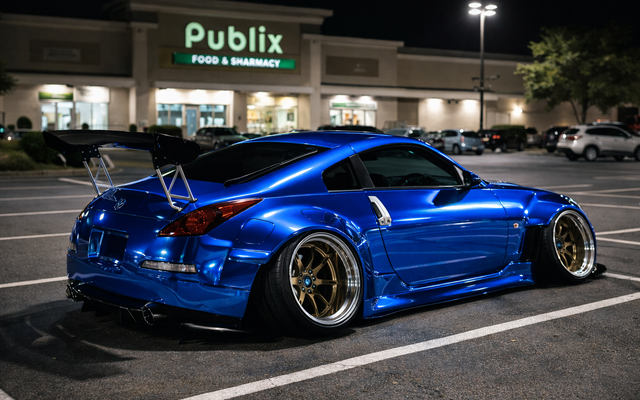
This muscle-derived sports car offers a distinctive combination of advantages to the sideways discipline, including a light aluminum frame, a transaxle-style drivetrain component that contributes to an perfect weight distribution, and the immense torque of a big LS V8 motor. This blend renders it an utter force on track, designed of starting and maintaining long drifts with seemingly easy deployment of power. For builders seeking exceptional bang-for-the-buck, the Nissan Z33 stands out as a excellent candidate. It arrives from the manufacturer with a stiff platform, a effective factory locking differential, and the responsive VQ series motor that provides sufficient power and torque for practicing and moving up in the sport. Its successor, the 370Z model, offers additional improvements in structural rigidity, steering geometry, and overall engine power, establishing its status as a favorite pick among competitive competitors. Additional legendary cars that deserve attention include the agile rotary-powered Mazda FC, the ubiquitous S13 Silvia/240SX, the torque-rich Ford SN95, the modern BMW E90, and the small yet unbelievably fun and instructive MX-5 Miata. All of these cars gives a distinct array of characteristics, complexities, and capabilities, but they all share the basic elements required to become a competitive drift machine.
However, picking the correct chassis is merely the first step. To access the true potential of any of these machines, substantial upgrades to the steering system and chassis control systems are completely essential. This is where the world of precision drift-spec parts enters vital importance. The most most game-changing improvement for a dedicated drift car is the installation of a drift-spec steering angle kit. These advanced assemblies, such as those manufactured by specialist companies like specialist manufacturers, are created to significantly enhance the chassis's maximum steering angle. A factory street car is highly restricted in how far its front wheels can pivot, a engineering limitation for public road operation. In oversteer driving, but, maximum steering input is frequently needed to manage and sustain a drift. An modification kit exchanges the OEM steering knuckles, tie rods, and potentially suspension arms with parts that allow the steered wheels to reach angles in excess of 70 or even 80 °, as opposed to a average factory angle of around 40 to 50 degs.
This vastly greater steering angle gives the driver with significantly greater control during a angle, allowing it to be far more straightforward to start a oversteer moment, hold it through a extended corner, and change seamlessly from one direction to the opposite. The contrast in drivability is truly transformative. Combined with a appropriately chosen angle kit is the every bit as essential upgrade to the car's damping system. Off-the-shelf or including high-end sport coilovers are simply not engineered for the unique and extreme requirements of drifting. A purpose-built system of adjustable dampers is of utmost importance. These specific suspension components incorporate custom piston tuning and spring strength that are optimized for the rapid weight transfer that is typical of sliding. When a driver starts a angle, the vehicle's weight is shifted forcefully to the front of the bend. Correct performance suspension handle this shift in a predictable way, permitting the vehicle to settle quickly and providing the operator clear feedback through the wheel and driver's seat. They additionally provide accurate setting of ride height, damping stiffness, and cross-weight, which are all key aspects of optimizing the chassis's dynamics to a specific venue or competition approach. Together, a precision-engineered angle modification system and a expertly selected system of drift-spec adjustable dampers constitute the absolute physical base upon which all later refinement is based.
Once the core components is in place, the subsequent essential step in the development is the detailed setting of the vehicle's alignment. This is the realm of vehicle alignment optimization, a process that can feel overwhelmingly complex to the newcomer but is, in reality, the key to turning a assembly of fast components into a unified and predictable machine. The most critical parameter of suspension geometry for drifting is definitely camber angle. Camber angle is the inclination of the tire relative to the perfectly straight plane when viewed from the forward of the vehicle. If the upper part of the wheel is angled towards the car, this is referred to as negative camber. For oversteer driving, an inward tilt on the front tires is universally applied and is regarded as essential. The drift telemetry software logic is deeply linked to vehicle dynamics.
When a vehicle is turning at high slip angles, the body rolls toward the outside of the bend. This body roll forces the outside steering tire to lose its optimal footprint with the track drift angle kits surface. By applying inward lean, the tire is pre-tilted to compensate for this tilt. As the vehicle rolls into the bend, the tire gains a better contact patch with the road surface, optimizing its bite at the exact time when it is most required for directional command. Usually, front axle adjustments for a competition sliding vehicle vary from approximately -3 degrees to as high as -5 degrees or even greater, depending on the details of the chassis setup, compound type, and operator style. The rear tires also use negative camber, but the settings are generally more modest and subtler than the front. Excessive inward lean at the rear can result in the chassis excessively prone to oversteer and challenging to control on throttle input, as it reduces the effective contact patch of the driven wheels during linear acceleration. Hence, rear axle adjustments are often in the vicinity of -1 degree to -3 degrees, striking a precise compromise between providing adequate lateral bite to help in starting and holding the drift while still maintaining usable hook-up for power-down the corner. camber angle is merely one element of the larger tuning puzzle, which furthermore encompasses toe, caster, and bump steer correction.
Toe refers to the angle of the tires when looked at from above. Toe-in means the front edges of the tires are nearer together than the trailing edges, while negative toe means the opposite. For oversteer, a small amount of front toe out is commonly run to sharpen the initial response directional response, making the chassis feel more nimble and ready to start a slide. Rear axle toe setting is generally set to neutral or a very small amount of toe-in to promote predictability under power. caster angle is the forward or aft angle of the kingpin axis when looked at from the side of the car. Increased positive caster enhances steering feel and stability stability, and it additionally adds to negative camber increase during cornering, which is very useful. Adjusting these settings is a detailed interplay where a adjustment to a single setting can and will affect the remaining parameters. The conventional approach for setting a chassis's alignment for competition has for a long time been a labor-intensive process of experimentation and feeling. A tuner or team would apply a modification based on experience, run the car on track, use the operator's personal feel and impressions, and then introduce another adjustment. This cycle would repeat again and again until the vehicle felt "right" or the allotted testing period ran out. This system is not only extremely inefficient in terms of time and resources, but it is also inherently inaccurate.
Human perception is a infamously subjective measurement tool, affected by many elements such as exhaustion, evolving track conditions, temperature, and simply the mindset of the driver on that particular run. What feels "loose" on one run might feel "tight" on the following pass, resulting in contradictory data and counterproductive adjustments. This traditional challenge in vehicle dynamics optimization is specifically where modern engineering tools has made its mark to revolutionize the methodology.
The rise and integration of advanced suspension tuning applications has introduced a new era for building and perfecting drift suspension tuning guide competitive drift cars. This new generation of systems, represented by cutting-edge products like modern telemetry hardware, work by physically measuring the live physical movement of the vehicle as it is being driven on the track. As opposed to using subjective impression, these systems collect quantifiable metrics on essential variables such as suspension travel, corner velocities, acceleration forces, lock position, and accelerator and brake pedal application. This collected data stream is then analyzed by advanced algorithms that can graph and interpret the information in a clear manner. For the first time ever, drivers and builders can observe specifically what the car is exhibiting at any given point of a lap. This function revolutionizes the entire chassis setup process. Think about the specific goal of setting the front axle negative camber for a given car. Rather than applying a change from -3 degrees to -3.5 degrees and then testing multiple laps to try and "sense" a change, a suspension tuning tool can give immediate and definitive information. The software can show graphically how the tire's grip is behaving during the key moments of a slide: initiation, sustain, and switch. It can show if the present value is enabling the outside front tire to keep ideal contact or if the rubber is overloaded on its external edge.
The tool can after analysis provide data-driven recommendations for modification. Perhaps the information shows that the tire is even overloading its edge at -3.5 degrees of negative camber, suggesting that a move towards negative camber, say -4 degrees, might be advantageous. Conversely, the data might indicate that the tread is failing to reaching optimal operating temp or that the inner shoulder is degrading too quickly, which could indicate that there is overly aggressive negative camber and a small reduction back to -3.2 degrees would be better ideal. This level of accuracy and practical intelligence was completely unimaginable in the days of solely manual tuning.
The effect of employing a comprehensive drift telemetry system goes well beyond merely setting alignment. It becomes an invaluable suspension tuning guide that is tailored to your exact car. When adjusting the rebound and compression values on your adjustable dampers, instead of using general tips or mimicking another car's setup, you can use the telemetry to observe how the chassis is reacting in response to your tweaks. The software can graph the wheel movement trace over a run, highlighting if the dampers are managing the chassis motion effectively or if they are allowing the car to bounce too much after a transition. It can aid in identifying issues like hitting the bump stops or losing droop, allowing you to introduce educated decisions to helper springs, rebound/compression rates, or ground clearance. This process extends similarly to the intricate process of suspension geometry optimization. In addition to camber angle, the tool can give data into how changes to toe and caster angle are influencing the chassis's stability during specific maneuvers of a slide. For example, it can assist you to determine the optimal amount of front axle toe out for your individual steering geometry and competition approach by analyzing the speed of initial reaction and the stability of the vehicle at maximum countersteer. This turns the system an extremely powerful performance optimization handbook that is dynamically updated by the real-world dynamics of your specific chassis on the tarmac. It shifts the whole endeavor from a dark art into a repeatable engineering process.
Moreover, the value of a system like modern telemetry is not restricted to professional tuners with extensive resources. For the club-level driver, it acts as an powerful force multiplier. It in essence gives the driver with the knowledge of a expert dynamics engineer without the associated overhead. It drastically shortens the learning curve by providing clear directions to challenges that would normally take seasons of trial and error to solve. A builder can see how their specific chassis reacts to specific inputs, developing a more intuitive understanding of vehicle dynamics in the journey. It also makes accessible professional performance tuning concepts, allowing anyone with the drive to optimize their machine to do so in a efficient and successful fashion. This is particularly valuable in a activity like drifting, where setup know-how has in the past been a closely guarded asset among elite teams. Now, that capability can be in the hands of every motivated driver.
In conclusion, the journey to constructing and optimizing the perfect championship-contending drift machine is a multi-faceted project that smoothly integrates classic engineering knowledge with revolutionary data technology. It commences with the strategic pick of a proven platform, then enhanced by the installation of non-negotiable drift-spec hardware like high-performance steering angle kits and correctly valved drift-spec coilovers. The build then advances into the precision phase of car suspension tuning, where parameters like negative camber, toe, and caster angle are meticulously adjusted to match the car's modified geometry and the driver's specific style. Finally, and what truly distinguishes the contemporary methodology from the traditional methods, is the use of a advanced suspension tuning application. This platform eradicates the guesswork and trial and error of purely feel-based adjustment by delivering quantifiable, actual data on how the chassis is truly functioning. It acts as an unparalleled suspension tuning tool, a actionable coilover setup manual, and a all-in-one performance analyzer. As a complete package, this complete methodology guarantees that each and every component of the competition vehicle—from the selection of the platform to the last adjustment on the suspension—is perfected for peak performance on the competition venue. It signifies the complete evolution of the art of drifting, merging mechanical pilot talent with data-informed vehicle setup to create the most dominant cars attainable.